


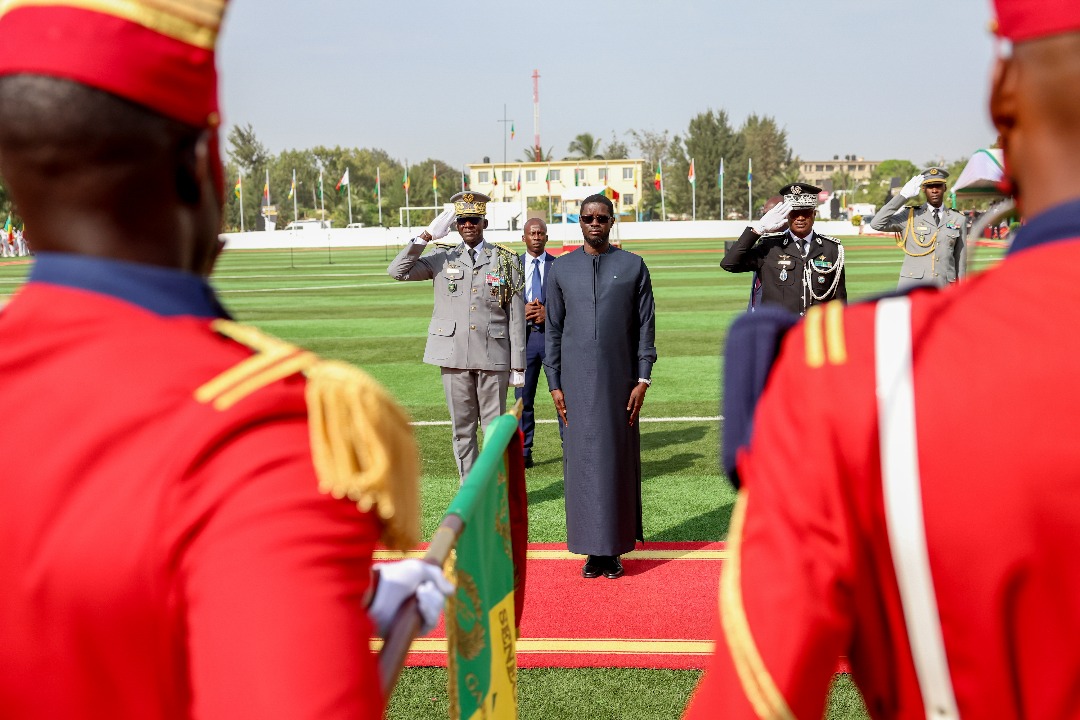
Senegal commemorated on Monday, 1 December 2025 the 81st anniversary of the massacre of the Senegalese Tirailleurs at Thiaroye.
The ceremony took place in the presence of high-level dignitaries, including His Excellency Adama Barrow, President of the sister Republic of The Gambia; the President of the National Assembly of Togo, Mr Komi Sélom Klassou; and the Vice-President of the Republic of Côte d’Ivoire, Mr Tiémoko Meyliet Koné.
Upon his arrival at the Thiaroye Military Cemetery, the President of the Republic, Supreme Commander of the Armed Forces, received military honours before solemnly laying a wreath in tribute to the African Tirailleurs massacred in December 1944.
This commemoration reminds us of the importance of preserving historical truth, defending justice, and passing on to future generations the memory of these heroes. Their sacrifice remains a pillar of our national consciousness and a landmark for building a united, sovereign Africa faithful to its history.
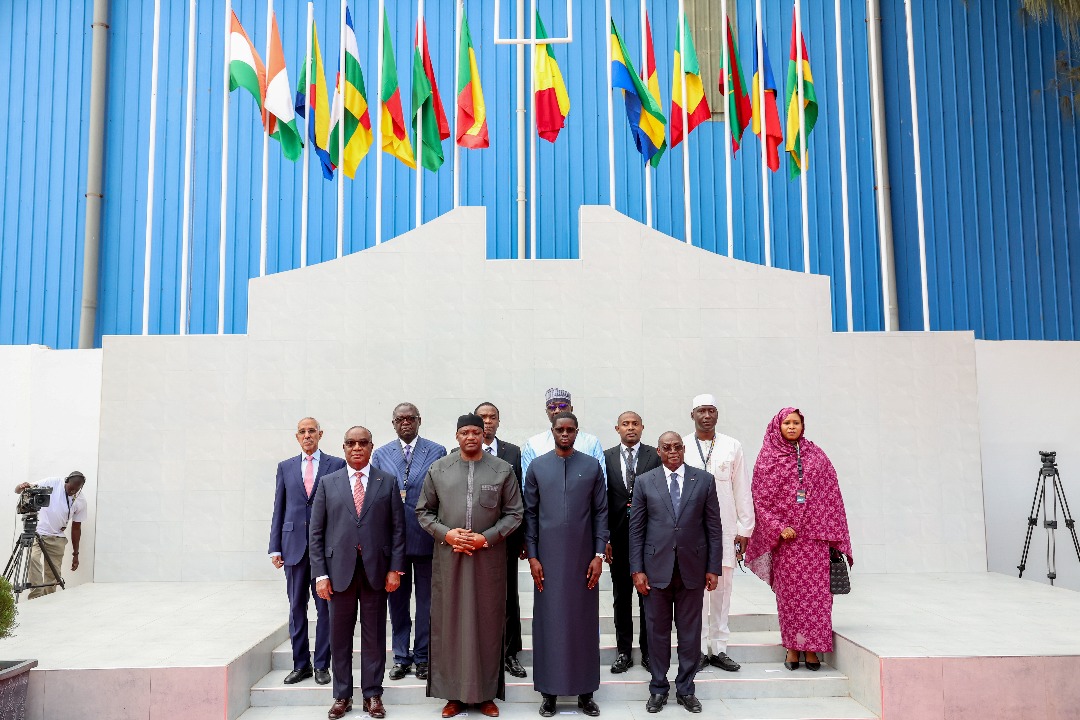
Below is the speech delivered by His Excellency Mr Bassirou Diomaye Faye, President of the Republic of Senegal, on the occasion of the commemoration of the 81st anniversary of the Thiaroye massacre:
Thiaroye, 1 December 2025 – Spoken word alone is authoritative
Mr President of the Republic of The Gambia, dear brother Adama BARROW,
Mr Vice-President of the Republic of Côte d’Ivoire, Madam President of the National Assembly of the Togolese Republic, Ladies and Gentlemen Heads of Delegation, Mr President of the National Assembly, Mr Prime Minister, Ladies and Gentlemen Ministers and Secretaries of State, Members of the Diplomatic Corps, Honourable Members of Parliament, Administrative and Religious Authorities, Ladies and Gentlemen, descendants of the families of the Senegalese Tirailleurs, Distinguished Guests, Dear People of Thiaroye, Ladies and Gentlemen,
At the outset, I wish first to greet and thank President Adama BARROW for agreeing to join us for this commemoration. I also thank the Heads of State and Government of Côte d’Ivoire, Togo, Cameroon, the Comoros, the Republic of the Congo, Mauritania and Chad, who sent high-level delegations, as well as all the friendly countries that kindly responded to our invitation.
More than a mere protocol gesture, your presence here in Thiaroye bears witness to an African consciousness that is asserting itself – through our shared history that is being rebuilt and through our common will to restore to our peoples the truth that was long withheld from them. On this day of national remembrance, we are gathered on this wounded soil of Thiaroye to recall that truth can never be erased. It always ends up demanding justice.
That is the meaning of our presence here: to honour the memory of the Senegalese Tirailleurs – African heroes who came from diverse horizons and shed their blood for the liberation of France.
Their fate was tragic once their mission was accomplished, for they were brutally murdered by the colonial army; their only crime was to demand payment of what was owed to them, recognition of their dignity, and respect for the word that had been given.
Today, once again, we honour their sacrifice and affirm that their struggle for justice and dignity will never be erased from our collective memory.
Although the massacre took place here on Senegalese soil, the blood that was shed was the blood of Africa. Consequently, commemorating Thiaroye means recognising that our destinies are linked. It means turning this tragedy into a foundation of pan-African solidarity and a pillar of the future we are building. It means renewing our solemn commitment to construct an Africa that remembers its past in order to fully live its present and look confidently toward its future.
I pay warm tribute to the Commemoration Committee, to historians, researchers and artists, to associations and to all those who – often in the shadows, sometimes against resistance – worked to reopen this long-sealed file.
Thanks to them, new avenues of investigation have been explored, and the repressed memory of this tragedy can finally be illuminated in the full light of history, in all its truth.
From the bottom of my heart I thank the people of Thiaroye, the victims’ families and the local authorities – tireless guardians of this memory. For decades you have carried the flame and ensured it never goes out, so that the world may never forget.
I also salute our valiant army, heir to the history of all those soldiers who served with honour. Thank you for your commitment to preserving this shared memory.
Ladies and Gentlemen, dear guests,
Last year, on the occasion of the 80th anniversary, we crossed a historic threshold. For the first time, France, through the voice of its President, used the right word: massacre. That right word, that recognition, restores to history the portion of truth that had been amputated from it.
Today, together with our African brothers and sisters, we undertake to continue this work of truth and memory. I welcome the official publication of the White Paper on the Thiaroye massacre.
This fundamental document – the fruit of scientific work and meticulous investigation – draws on archives, the testimony of witnesses and material evidence to reconstruct the facts and restore dignity to the martyrs.
The White Paper now becomes an indispensable reference for understanding Thiaroye. It confirms that memory can no longer be a territory of concealment; it must become a space of justice, moral reparation and collective reconstruction.
So that this truth may be visible, so that it may inhabit our public space as much as our consciences, I had the honour of laying the foundation stone of the Thiaroye Massacre Memorial Stele, located between the camp and the cemetery, thereby uniting the two sites of truth.
This Stele will not be a mere stone monument. It will form the heart of a vast memorial complex that will include a plaza for commemorations, educational and cultural spaces dedicated to young people, and residences to host researchers from around the world who come to work on colonial histories and memories.
The Stele will make Thiaroye a living place of memory, a beacon of historical truth and a citadel of knowledge for generations to come. It embodies our determination to transform pain into strength, remembrance into learning, and the past into a lever for a future of recovered sovereignty and dignity.
This work of memory goes beyond simple commemoration. It is also oriented toward the future. That is why the Government undertakes to strengthen the place of the history of the Thiaroye massacre in our school curricula. Our children must know its events, its actors and its narratives. They must understand the mechanisms of colonial domination and the value of resistance. This transmission is the very foundation of our national consciousness, our citizenship and our pan-African commitment.
Thiaroye is not merely a historical event. It is an entire symbol: a symbol of the violence of the colonial system, but also of African resistance and of our irrepressible thirst for freedom and sovereignty.
Dignity has no price. The question of reparations and justice must now be raised calmly yet firmly, in a dialogue grounded in historical truth and in the duty of justice toward the victims’ families.
In conclusion, the struggle for the memory of Thiaroye is a struggle for the soul of Senegal and of Africa. A struggle so that never again may a people be denied its history, its dignity and its right to exist freely.
For my part, I will spare no effort to ensure that the memory of our martyrs continues to live in our collective memory and in that of generations to come.
Long live Senegal! Long live a united, free and prosperous Africa.