


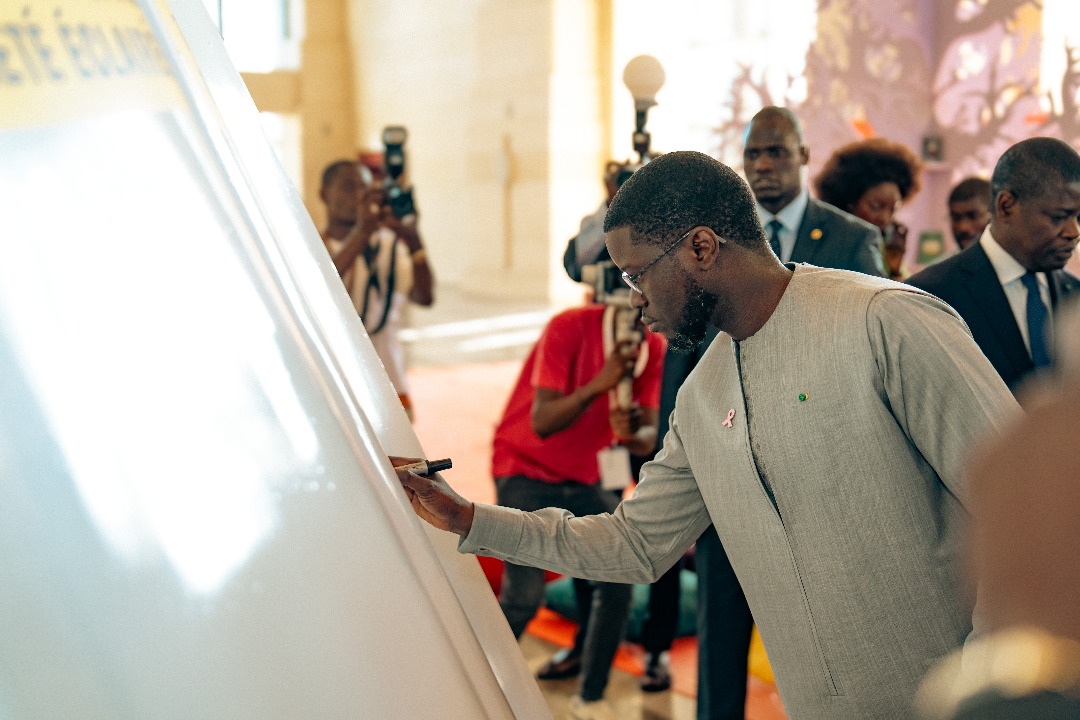
The President of the Republic, Bassirou Diomaye Faye, presided over the opening ceremony of the National Forum on Books and Reading this Thursday morning, a major event dedicated to reshaping cultural policy and revitalizing the book sector in Senegal.
This forum, a true laboratory of ideas, brings together writers, publishers, librarians, teachers, researchers, and professionals from the literary world, united by a shared ambition: to make books and reading levers for cultural and educational transformation in the country.
In his address, the Head of State emphasized the emancipatory power of books, stating that they “liberate, inspire, and shape the aspirations of peoples as well as the ideals of nations.” Sharing a personal memory, he said with emotion: “I loved reading because I always saw my father read.” A heartfelt statement that underscores the fundamental role of family in passing down a love for knowledge.
President Bassirou Diomaye Faye reaffirmed the State’s commitment to making books a central tool in building a sovereign, just, and prosperous Senegal, true to the ideal of a nation enlightened by knowledge.
Below is the full text of the President of the Republic’s speech at the official opening ceremony of the National Forum on Books and Reading:
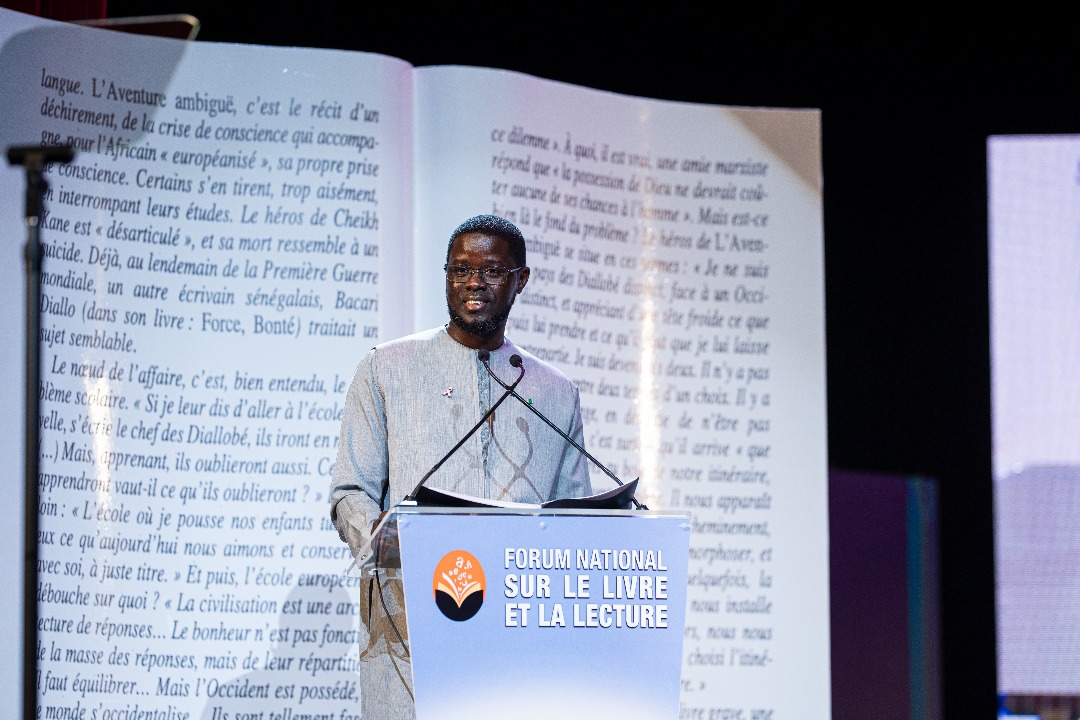
Ladies and Gentlemen, members of the Government, Mr. Minister of Culture, Crafts, and Tourism, Mr. Secretary of State for Culture, Creative Industries, and Historical Heritage, Excellencies, Ladies and Gentlemen, representatives of the diplomatic corps, Ladies and Gentlemen, representatives of international institutions, Ladies and Gentlemen, stakeholders in the book industry, Ladies and Gentlemen, representatives of the literary and artistic community, Ladies and Gentlemen, experts, Dear students, Dear guests, Ladies and Gentlemen,
The book. This single word evokes the light that humanity wrests from the darkness of ignorance to build its freedom. The book transcends time, shortens distances, crosses civilizations, and connects consciences. The sovereign, just, prosperous Senegal, rooted in strong values, that we aspire to build will be forged with rediscovered identities, elevated souls, and free minds. The school of this freedom is the book. That is why I am delighted to be here today among those who, through their works, professions, and passions, give knowledge a voice, memory a form, and hope a face. I salute you, artisans of words and intellect, you who bring to life the silent miracle of reading. You are the invisible builders of our shared humanity. Writers, publishers, distributors, printers, literary critics, researchers, librarians, booksellers, readers—you all contribute, each in your own way, to building, enriching, and promoting the literary and cultural heritage of our country, shaping its identity, and spreading our cultures and the soul of our people across the world. In truth, there is no civilization without stories, no nation without memory, no progress without reading. The book is the outstretched hand of the mind toward something greater than itself. It transforms knowledge into wisdom, words into heritage, and imagination into the power of the future. In every book, there is a fragment of eternity, a piece of the human soul, a spark of what is best in us: the ability to understand, to dream, and to hope still.
Ladies and Gentlemen, Before any policy, before any reform, before any transformation, there must be an imagination. And this imagination is shaped by writers. The writer is not merely a craftsman of language; they are its demiurge. They mold it, twist it, magnify it—not for ornamentation, but to restore its power to awaken. In their hands, language ceases to be a mere tool: it becomes a living organism, a breath that shapes consciences.
Each word they choose is an act of resistance against ignorance and the darker parts of the world, a way of refusing oblivion and affirming that words remain the first victory of the mind over chaos. For literature does not explain the world: it transfigures it. It reveals its silent zones, its hidden wounds, its unspoken hopes. It makes visible what the distracted gaze no longer sees and renders habitable what fear or silence had abandoned. Thus, through the work of our writers, the Senegalese spirit has become a bridge between souls and continents. Their works, written here but inspired by the universal, make Senegal’s name resonate in circles of knowledge, in schools and universities around the world, in the most distant homes, and in the minds most open to the Other. And thanks to the miracle of translation—that gentle bridge that allows cultures to speak without erasing each other—their voices cross borders to remind humanity that, beneath the diversity of languages, there is only one language: that of the heart and the mind. But beyond creating beauty, the writer is an awakened citizen, a being of lucidity and courage. They observe social dynamics, question the disorders of the present, denounce injustice, reveal the secret wounds of the people, and transform them into material for hope. They do not preach; they illuminate. They do not condemn; they understand. And in this way, they contribute to building the city—not as orators, but as watchmen. In the solitude of their writing, they dialogue with History. They remember those who were and anticipate those who will come. For the writer never speaks only for today: they speak for the eternity of the present, the past, and the future.
Their words traverse time like a lamp that others will carry when the night grows darker. Our Senegalese and African literature brilliantly illustrates this vocation. From Bakary Diallo to Léopold Sédar Senghor, from Birago Diop to Ousmane Sembène, from Abdoulaye Sadji to Aminata Sow Fall, from Cheikh Hamidou Kane to Mariama Bâ, from Ken Bugul to Boubacar Boris Diop, to Fatoumata Ba Diallo and many others, our writers have shaped the consciousness of entire generations. They have revealed Africa to itself and to the world, without servility or arrogance, but with the quiet dignity of those who know that words are an act of faith. Through them, our societies have learned to look at themselves without complacency or hatred, but with clarity. Through their works, we have better understood our own history, from the colonial period to the convulsions of the contemporary world. They have given faces to silent suffering, a voice to forgotten silences. And in their pages, love, friendship, fraternity, and solidarity regain meaning: they are no longer abstract values but living forces that mend the fractures of the world.
Ladies and Gentlemen, The history, sociology, and psychology of other peoples become familiar to us, as if we had lived in those foreign lands, in different eras, and intimately known those distant populations. What a beautiful image of religious tolerance in West Africa offered by Amadou Hampaté Bâ in The Life and Teachings of Tierno Bokar, the Sage of Bandiagara! What an accurate depiction of the oppressive atmosphere of modern African cities in Cruel City by Eza Boto! Can we imagine a more powerful testimony to the love for a mother and the pain of loss than The Tree Bent Down by Mariama Ndoye?
And the list is far from exhaustive. Our relationship with books is thus marked, on one hand, by intimacy and, on the other, by otherness, as we engage indirectly, through universal stories, with an infinite number of real and potential readers across time and space.
Ladies and Gentlemen, Writers and stakeholders in the book industry deserve our full recognition. They are the custodians of an essential mission: to keep the national consciousness awake, to nurture the flame of knowledge, and to preserve the dignity of the mind. That is why I have always believed they must be full-fledged actors in the systemic transformation of our country. For a nation cannot be transformed sustainably without first transforming its imagination, elevating its reading, and nourishing its thought. I wish to commend the admirable work done by the women and men of the book and reading sector. Their often silent commitment reflects a rare sense of public cultural service, enlightened patriotism, and assumed citizenship. Through their initiatives, they maintain the vital link between knowledge and society, between memory and the future. I would like to pay special attention to the Dakar International Book and Educational Materials Fair and the National Book Salon. These two major events have sustained Dakar’s status as a leading platform for book-related activities and publishing in our sub-region. My will, and that of my Government, is clear, and I wish to reiterate it here: to work with all professionals to make the necessary adjustments and reinvent these precious moments of intellectual breathing space for book enthusiasts in Africa and beyond. In short, to promote a model that, combined with the Biennale of African Arts, would restore the cultural hub so eagerly anticipated by our country’s creative community.
The dynamism of the book sector, as well as the diversity and complexity of the challenges it has faced for many years, requires, however, that major shifts be made and reforms undertaken. I have therefore deemed it necessary to bring together all stakeholders for a moment of reflection on the challenges of the book and reading sector, which should lead to concrete solutions. I commend the mobilization of all the actors present here and their significant contributions to the success of this Forum. This unprecedented event is, above all, yours. It will reflect your commitment, your imagination, and your sense of collective purpose.
Ladies and Gentlemen, If I wanted this National Forum on Books and Reading to take place, it is first and foremost out of recognition: recognition of the remarkable work of men and women of letters, recognition of the vitality of Senegalese creation, and recognition of the structuring role of writers’ associations and professional organizations in building a Senegal of knowledge and culture. I consider them true partners in public service, called to support the implementation of cultural policies outlined in the National Transformation Agenda for 2050. This meeting must therefore be a founding moment, one of sincere dialogue and a renewed pact between the State and the book sector’s actors.
We must collectively reflect on concrete, sustainable, and equitable solutions. I therefore invite you to focus your discussions on, among other topics:
- The development of an innovative policy to modernize libraries and reading rooms in schools, universities, and higher education institutions, in light of opportunities and innovations fostering the rise of digital books;
- The structuring and financing of the entire book sector to make it a vector for economic and social development, within the framework of our actions related to cultural and creative industries;
- The challenge of digitization and artificial intelligence. I also place particular importance on the publication of works that reflect our identities, especially those written in our national languages. For the cultural and intellectual sovereignty we aspire to also involves reclaiming our own voice. Writing in our languages is to transmit our worldview; it is to tell the world that we think as Senegalese, without ceasing to belong to the universal.
Ladies and Gentlemen, The National Forum on Books and Reading represents a privileged framework for exchange, sharing, consultation, proposal, and action. I urge you all to make it a landmark moment in our cultural policy. It is also under this condition that we will remain faithful to the memory of those departed figures who, for so many years, made every sacrifice with generosity, commitment, and dedication to ensure that books and reading shine at the pinnacle of the Senegalese spirit. May they rest in peace, and may the Lord abundantly reward their good deeds.
In conclusion, in my capacity as the First Protector of Arts and Letters of Senegal, I reaffirm my commitment to supporting the cultural sector as a whole and the book and reading sector in particular, and I wish you every success in your work. With these words, I declare the National Forum on Books and Reading open and thank you for your attention.