


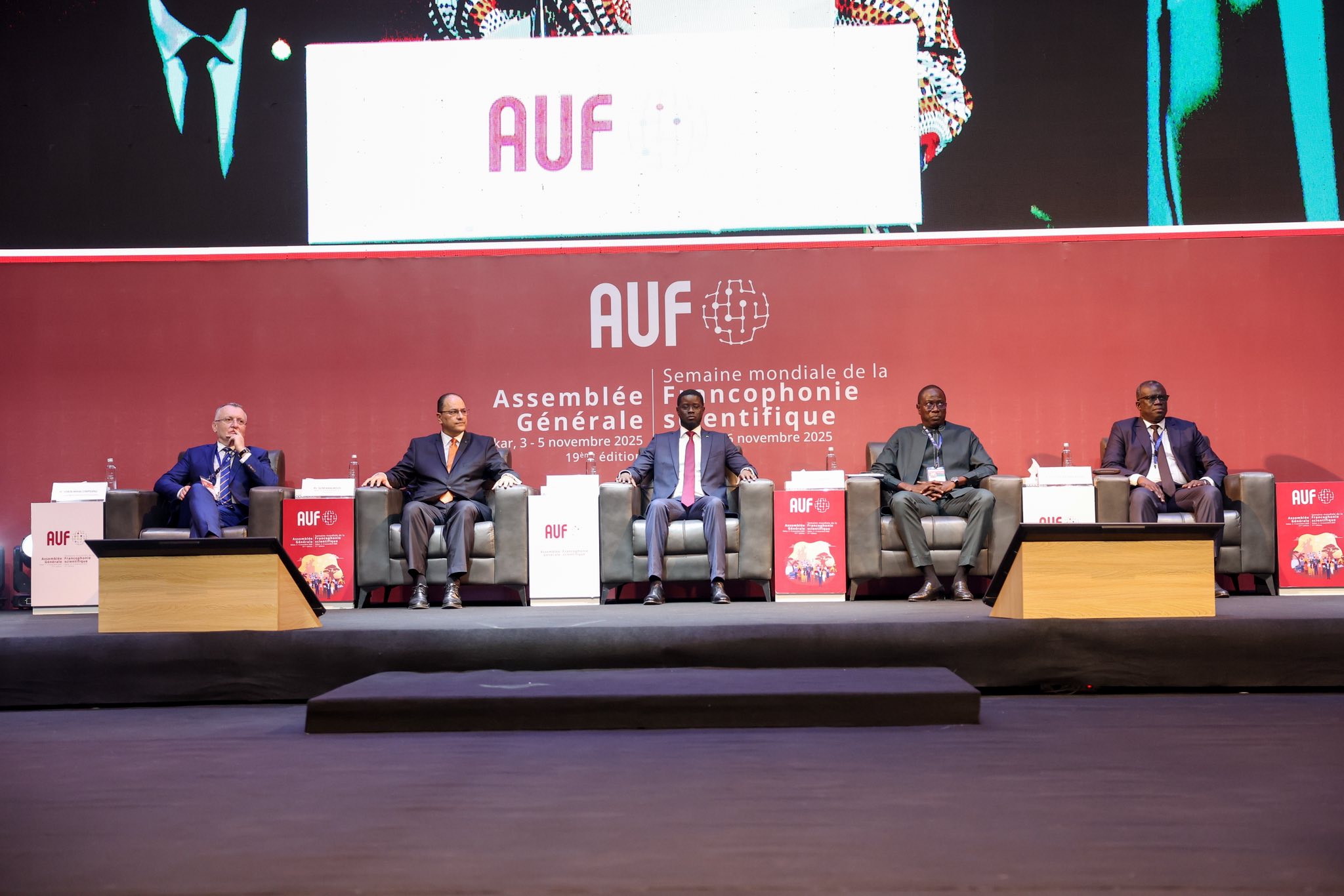
The 19th General Assembly of the Agence Universitaire de la Francophonie (AUF) opened this Monday in Dakar, under the chairmanship of His Excellency President Bassirou Diomaye Faye.
This major international gathering brings together university leaders, researchers, and decision-makers from several French-speaking countries around a common goal: making knowledge and science levers for development and integration.
The Head of State emphasized that science and culture are inseparable and form the foundation of nations' sovereignty. He called for increased investment in research, innovation, and endogenous knowledge to build an intellectually and technologically autonomous Africa.
Senegal, a land of hospitality and knowledge, thus reaffirms its commitment to promoting an open, inclusive, and future-oriented scientific Francophonie.
Find below the full text of the speech by His Excellency Mr. Bassirou Diomaye Diakhar FAYE, President of the Republic Dakar, November 03, 2025 – Spoken version prevails
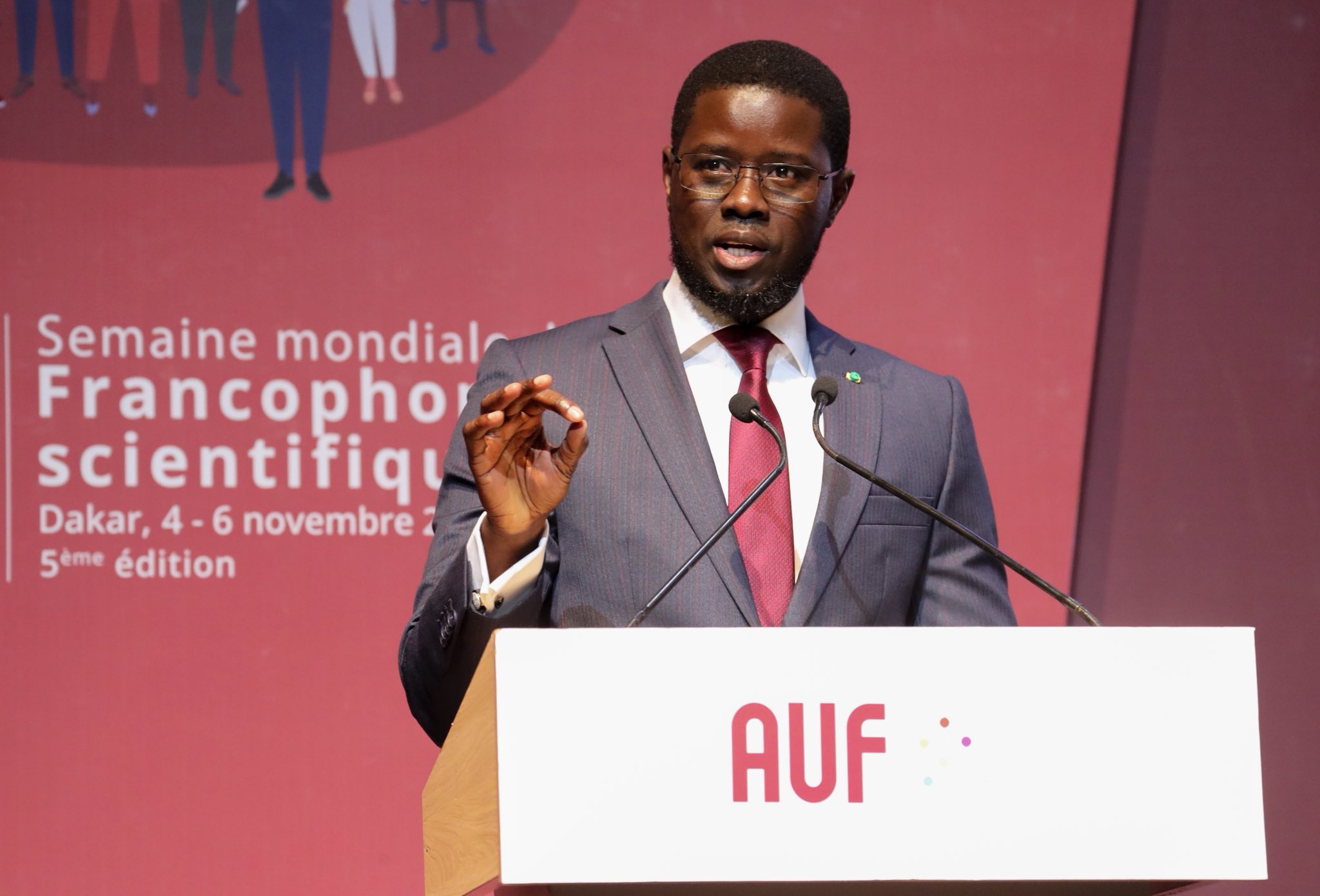
Ladies and Gentlemen, Members of the Government, Mr. President of the Agence Universitaire de la Francophonie, Mr. Minister of Higher Education, Research, and Innovation, Ladies and Gentlemen, Ministers in charge of Higher Education from member States and Governments, Your Excellencies, Members of the Diplomatic Corps, Mr. Rector of the Agence Universitaire de la Francophonie, Mr. Rector of Cheikh Anta Diop University of Dakar, Dear faculty and researchers, Dear students, Honorable guests, Ladies and Gentlemen,
Cheikh Anta Diop, the eminent African scholar, addressing Senegalese and African youth, said: “Arm yourselves with science to the teeth! Reclaim your cultural heritage.”
From this admirable injunction, I retain the urgency of action and its necessity.
Through this call, Cheikh Anta Diop reaffirms the consubstantial link between science and culture. Indeed, science, even when described as “hard,” is never truly neutral or disembodied. It is laden with meaning. History is replete with examples of science being instrumentalized to impose ideologies at the expense of other peoples.
In this regard, it is fundamental that the African continent invest massively in science and technology, particularly in the autonomy of knowledge. This autonomy must begin with teaching at all levels, including higher education and research, of endogenous knowledge, which forms an inalienable part of universal science.
Furthermore, beyond political and economic integration, we must consider the integration of higher education in Africa and, above all, the integration of knowledge across Africa.
In reality, this integration of knowledge was once a lived reality in West Africa, at a time when the transmission and sharing of knowledge mediums, as well as the mobility of knowledge bearers, constituted a true vocation.
And yet! The vibrant centers of the University of Pire Khaly Amar Fall in Senegal, the localities of Chinguetti in Mauritania, or Timbuktu in Mali provide ample evidence of the existence of robust traditions—traditions related to the promotion of sciences and the circulation of knowledge and scholars in eras long past.
Ladies and Gentlemen,
The Agence Universitaire de la Francophonie has been working since its inception to foster scientific integration within the Francophone space, promote inclusion, and pursue scientific autonomy. However, it is essential that this mission be carried out in a spirit of openness to other linguistic areas and cultural models.
That is why I am delighted to chair this morning the opening ceremony of the 19th General Assembly of the AUF, coupled with the fifth World Scientific Francophonie Week.
I therefore extend a warm welcome to our guests on the African soil of Senegal—a land of hospitality, culture, and knowledge-sharing.
Welcome home!
The bond of knowledge is undoubtedly the strongest alongside blood ties, for it is built on the natural inclination to share and on otherness.
Senegal, a founding member of institutional Francophonie, has hosted since 1974 the headquarters of the AUF’s West Africa Bureau—one of the oldest in the Francophone space, encompassing 12 countries and 135 universities in the sub-region. All Senegalese universities are members, as are a large portion of the higher professional education institutes (ISEP).
Senegal is committed to the dynamics of scientific integration in Francophone West Africa. This integration involves implementing training programs, research training, research, and innovation across the sub-region.
Ladies and Gentlemen,
The contemporary challenges of higher education are numerous. They include training critical masses of senior technicians, engineers, and scientists across all disciplines; the digital transformation of higher education through curriculum reform, teaching methods, and management; student mobility, faculty-researchers, and researchers; the relevance of training in the face of labor market changes; the necessary adaptation to societal issues; and the emergence of hubs for patent creation to support our development programs.
Consequently, in a world where divides between states are deepening through science, technology, research, and innovation, it is essential that countries of the Global South promote a scientific culture rooted from early childhood through higher education, in both non-formal and institutionalized modes of teaching and training.
Higher education has a crucial role to play in reversing the current trend of disaffection with scientific disciplines in our countries. As African history demonstrates, this trend is not inevitable. I therefore call on higher education authorities, faculty-researchers, and researchers, in a surge of patriotism, to join efforts, demonstrate innovation and creativity, so that African youth rediscover the taste, desire, and passion for mathematics, science, and technology.
Ultimately, the Senegal-2050 Vision places fundamental importance on higher education, research, science, technology, and innovation. Major reforms will therefore be undertaken, stemming from the reflections of the National Agenda for the Transformation of Higher Education, Research, and Innovation (ANTESRI).
Radical breakthroughs are envisioned. This includes training options, with a significant focus on reforming content and teaching science, techniques, and endogenous knowledge. The ambition is also to orient higher education and research toward economic and social development and the well-being of the most vulnerable populations.
Inclusion, consideration of our realities, integration, mobility, and innovation do not seem to us contradictory options. They are complementary and remain the foundations of a higher education system more in tune with our national realities.
Ladies and Gentlemen,
The digital revolution offers us unprecedented opportunities that we must absolutely seize. Unlike the Industrial Revolution, which our countries are still catching up with, we must be present at the rendezvous of History with the Digital Age.
We must transform our relationship with digital technology—turning technologies into capitalized academic knowledge, fully mastered techniques and technologies, applications beneficial to populations, and the creation of innovative businesses and startups.
The launch by Senegal of its first satellite is part of these strategic choices.
This is the trajectory our country has decided to explore through the Technological New Deal, which aims to make digital technology a vector of development capable of transforming all sectors to support our ambition for sovereignty. This national program seeks to achieve Digital Sovereignty; generalize the Digitalization of Public Services; enable the Development of the Digital Economy; and position our country as an African Leader in Digital Technology.
Ladies and Gentlemen,
It is important that the AUF remain at the forefront of innovation in higher education by pursuing objectives that facilitate synergies among faculty-researchers, researchers, and public and private decision-makers.
The Francophonie, founded on the promotion of cultural and linguistic diversity, must also give greater prominence to national languages in its research and innovation projects, alongside French. This orientation is particularly close to our hearts in our ambition to enhance our cultural heritage.
Indeed, threats to diversity affect all languages without exception, including our local languages. Respect for diversity requires that all idioms, in a relationship of equity, collectively contribute to the advancement of the light of knowledge.
This is a matter of dignity as much as pragmatism. It is above all a question of sovereignty.
I am also pleased to note that in recent years, the AUF has engaged in a process of diversifying its programmatic offerings, giving significant attention to youth and women’s entrepreneurship and professional insertion.
I commend in this regard the implementation in Senegal of two projects that align with the Government’s priorities:
- the ENTREPRENDRE project, which aims to develop an entrepreneurial culture in universities and support student project leaders;
- and the “Sustainable Urban Mobility and Employment” project, whose objective is to create an inclusive ecosystem for training and insertion into sustainable urban mobility professions.
In the same vein, I hope that the AUF will work more to explore best practices in the certification of prior learning. The goal is to support population categories that struggle to fully valorize their skills due to the lack of academic and institutional recognition.
Ladies and Gentlemen,
The most pressing challenge in the Francophone space, and particularly in Africa, is addressing the sustained aspirations of our youth, who constitute the overwhelming majority—60%—of our community.
All our actions must ultimately aim to provide solutions to youth issues in education, training, or employment.
To this end, we must strengthen scientific diplomacy, capable of facilitating rapprochement between political decision-makers and knowledge bearers.
Ladies and Gentlemen,
Once again, I salute this AUF initiative so that, within the Francophonie, knowledge and human-scale research continue to meet the needs of our populations.
By gathering today, you affirm that knowledge has meaning only if it serves human progress and the specific needs of every society.
I congratulate you on this commitment and wish you fruitful and inspiring exchanges.
With these words, I declare open the nineteenth edition of the General Assembly of the Agence Universitaire de la Francophonie, as well as the fifth World Scientific Francophonie Week.
Thank you for your kind attention.