


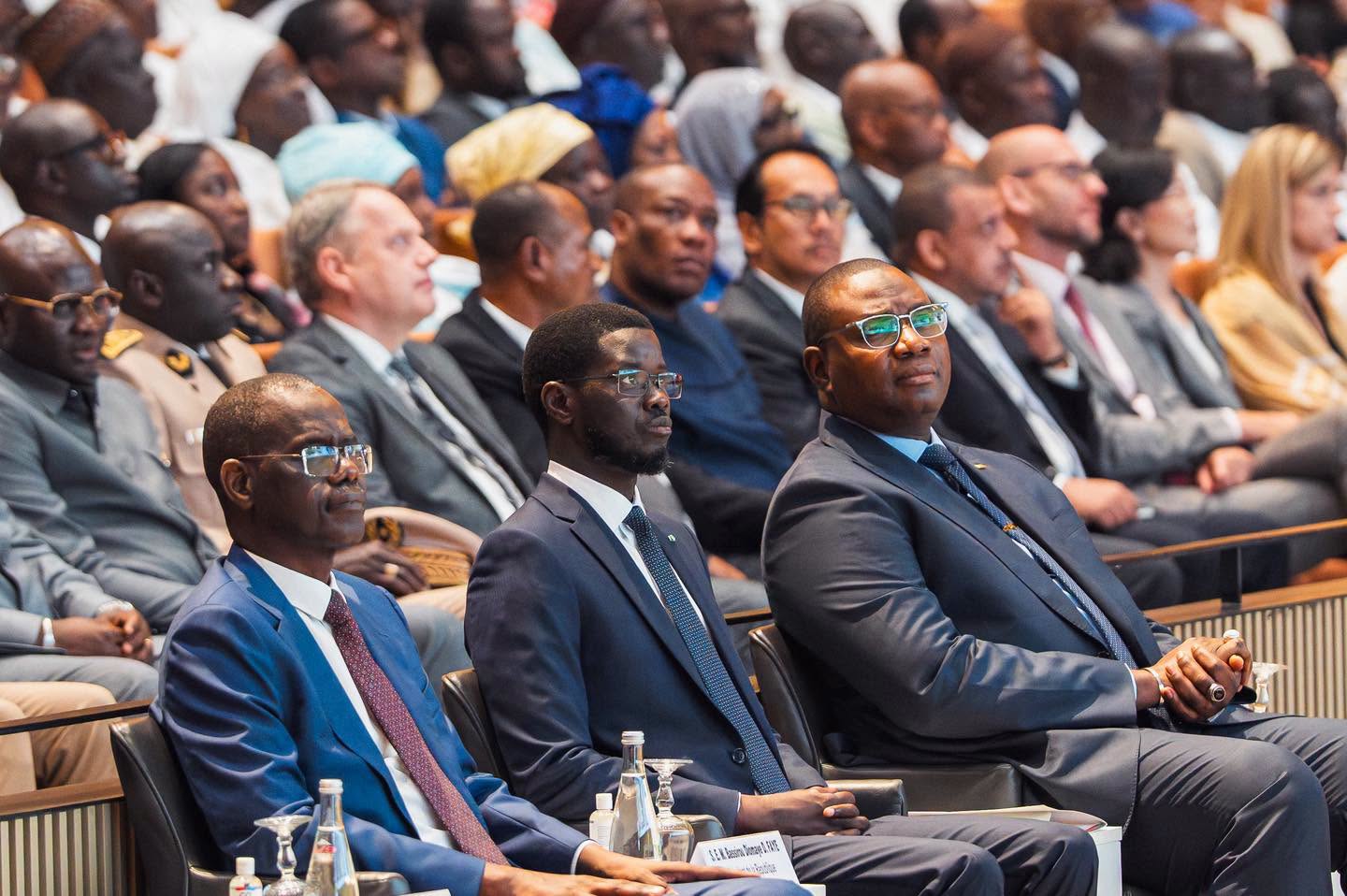
The President of the Republic, His Excellency Bassirou Diomaye Diakhar Faye, chaired a meeting on Thursday at the CICAD with Senegal's territorial executive authorities, focusing on the implementation of Act IV of decentralization and the reform of the Territorial Hubs.
At the heart of this vision lies a clear economic ambition: to unlock the competitiveness of every territory by harnessing its genuine potential. Driven by the National Transformation Agenda Senegal 2050, the Territorial Hubs are designed to serve as engines of endogenous and sustainable development, built on the country's own resources and firmly rooted in its local communities.
They do not constitute an additional administrative layer. Nor do they encroach upon the powers of locally elected officials. Rather, they intervene where isolated action reaches its limits and where pooling resources and efforts becomes essential. As instruments of coordination, strategic investment, and wealth creation, they provide territorial executive authorities with the means to act collectively and more effectively.
The Head of State emphasized that this reform is grounded in a method based on trust and co-construction. The result of several months of consultations involving nearly 3,000 stakeholders, it reflects the conviction that transformation cannot be decreed from Dakar but must be built within local communities, in close connection with the realities and aspirations of the people.
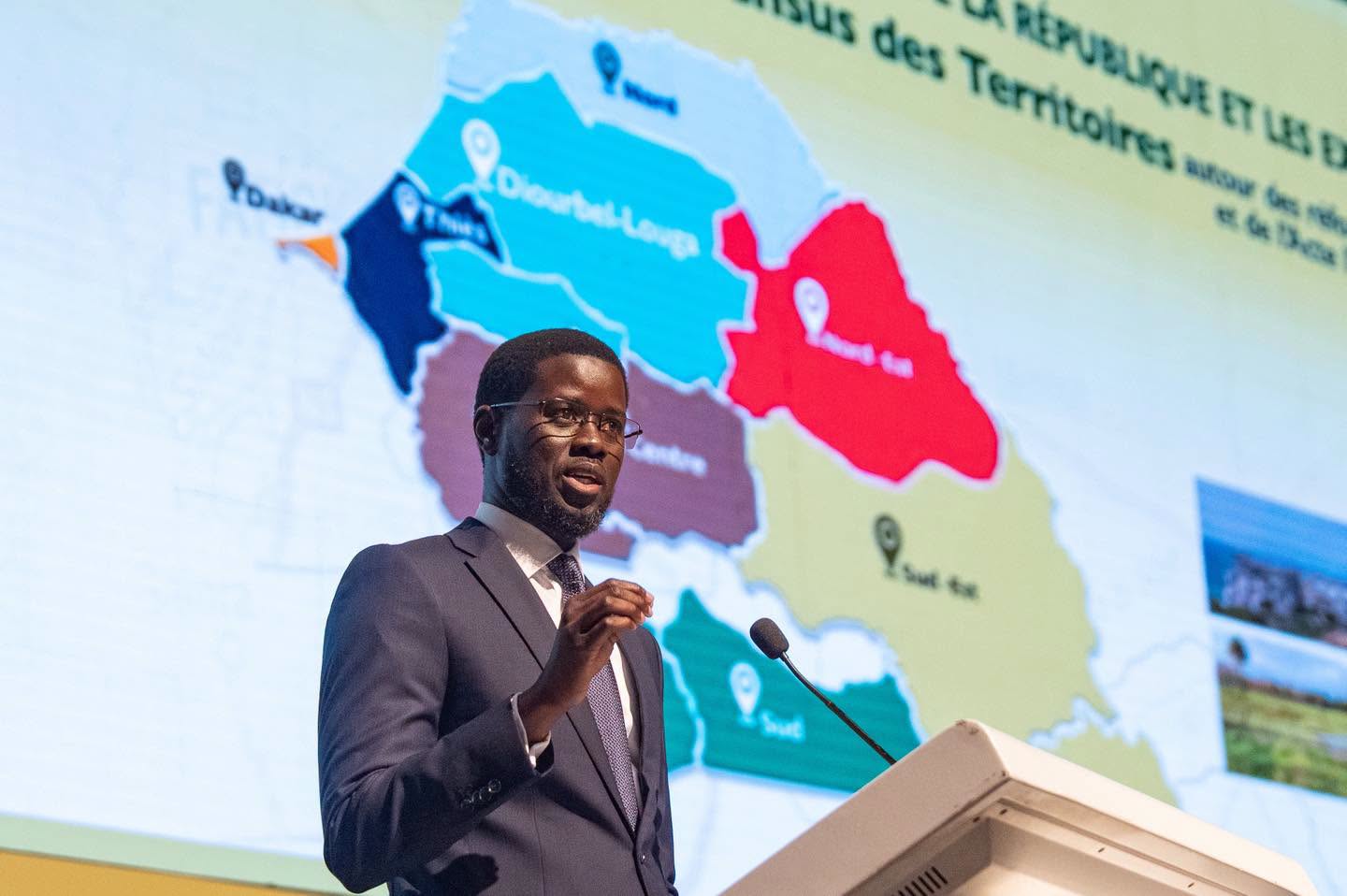
CICAD, 2 July 2026 – Only the spoken word shall prevail
• Mr. President of the National Assembly
• Mr. Prime Minister
• Mr. Minister of Urban Planning, Local Authorities and Territorial Development
• Ladies and Gentlemen, Ministers
• Ladies and Gentlemen, Governors
• Ladies and Gentlemen, Prefects
• Messrs. Presidents of Associations of Local Elected Officials (UAEL, AMS, ADS, REELS)
• Ladies and Gentlemen, Presidents of Departmental Councils
• Ladies and Gentlemen, Mayors
• Ladies and Gentlemen, Representatives of Technical and Financial Partners
• Ladies and Gentlemen,
It is with great pleasure that I welcome today those who carry, every single day, the concrete destiny of our territories. At the level of our communes, departments, regions, and future Territorial Poles, you are the first servants of the Republic. It is through contact with you that the State ceases to be an abstraction. It is through you, closest to our fellow citizens, that it takes on a face, a voice, and decisions.
Senegal has embarked on an irreversible dynamic of systemic change that affects our development policies as well as our values and daily actions. It is this dynamic that underpins and justifies the creation of the Territorial Poles.
The National Transformation Agenda Senegal 2050, our reference framework for public policies, gives them a decisive role. It positions them as the engine of endogenous and sustainable development. The goal is fundamentally to awaken the economic competitiveness of each territory based on its real potential, supported by structuring programmes and tools that are consistent with our planning instruments.
A reform of this magnitude is only meaningful if it is shared, understood, and well received. It is with this conviction that I instructed the Minister in charge of Local Authorities to conduct broad consultations with all stakeholders across the entire national territory to share the proposed reforms.
You have understood that the transformation we aspire to cannot be decreed from Dakar. It is built with you, in your local communities, closest to realities, closest to urgencies, and closest to the hopes of our fellow citizens. I wish to express here my satisfaction with the commitment shown by all actors throughout this process. Your interest has not wavered.
Ladies and Gentlemen,
This meeting is part of the ongoing dialogue that I have been keen to maintain with you during my visits to the territories.
The exchanges we have had on your concerns, your development priorities, and the expectations of our populations reinforce my conviction that consultation must remain at the heart of our action.
This is why I wanted to establish this framework for dialogue on a permanent basis, similar to the National Decentralisation Day already included in our republican agenda. It must provide territorial executives, local authority staff, partners, and populations with a permanent space for listening and reflection on decentralisation issues.
To fulfil this promise, its format must be rethought and adjusted to today’s realities, so that it fully serves reflection and the implementation of ongoing reforms, particularly Act IV of Decentralisation.
Our country has experienced several acts of decentralisation. Each has marked a stage and brought real progress, and it would be unfair not to recognise this.
But fidelity to this history also demands lucidity. Competences have remained fragmented, resources often insufficient, and too many of our fellow citizens have retained the feeling of a State that remains distant from their concerns and aspirations.
The Act IV we are launching today is not just another administrative reform. It is a founding act and an act of trust. It stems from a clear choice: to make territories the true engines of our national transformation.
To this end, we will provide local authorities with the effective means to exercise their competences by sustainably strengthening their financial, human, and technical capacities, while respecting ethics and good governance.
To carry this ambition, the refoundation of our territorial governance is structured around four major orientations.
The first orientation aims to modernise our territorial organisation, strengthen the proximity of public action, and clarify the responsibilities of the various actors, for a more readable, coherent, and effective public action.
The second orientation makes performance, territorial equity, and the strengthening of territorial engineering the guiding principles of our action. It must improve support for local authorities, enhance local initiatives, and better measure the results achieved in each territory.
The third orientation concerns what underpins the credibility of any decentralisation policy: resources. There can be no increased responsibilities for local authorities without adequate resources allowing them to fully exercise their missions.
In this regard, I wish to commend the efforts already made by the State in recent years, which have resulted in a significant increase in resources transferred to local authorities. This effort must be appreciated in its entirety, taking into account not only the allocations from the Decentralisation Endowment Fund (FDD) and the Local Authorities Equipment Fund (FECT), but also public investments, programmes, and projects implemented for the direct benefit of the territories.
Nevertheless, everyone recognises that the financing of decentralisation remains a major challenge. This is why I instruct the Government, in conjunction with the Minister in charge of Finance and Budget and the Minister in charge of Local Authorities, to examine the ways and means of continuing to progressively improve the resources allocated to local authorities.
In this perspective, the expected reforms of the FDD and FECT can be undertaken to better meet the needs of the territories and improve the predictability of the resources intended for them.
As our country consolidates its economic situation and regains more favourable budgetary margins, the question of a progressive revision of the VAT indexing mechanism may be examined, with the aim of sustainably increasing the volume of transfers to local authorities, while respecting the financial balances of the State.
In parallel, we will modernise local taxation and strengthen the capacity of local authorities to contribute to the economic development of their territories.
Finally, the fourth orientation aims to promote cooperation between territories, the pooling of resources, transparency in local public management, and good governance. It is in this same logic that the reform of the Territorial Poles fits. They are called upon to become instruments of coherence, solidarity, and performance.
Ladies and Gentlemen,
The Territorial Poles are not an additional administrative structure. They represent a balanced and pragmatic path, fully in line with our legal framework.
They do not constitute a new level of local authority and do not remove any existing one: they articulate and strengthen them. They do not encroach on your competences; they intervene where isolated action reaches its limits and where pooling becomes necessary.
The Territorial Poles are thus instruments of coordination, pooling, and territorial development designed to support integrated planning, structuring investments, economic promotion, and the mobilisation of financing at the territorial level.
Far from replacing the territorial executives that you are, they give you the means to act together more effectively.
Ladies and Gentlemen,
The success of this reform also depends on effective governance based on dialogue, coordination, and shared responsibility among all stakeholders.
To this end, the consultation, steering, and monitoring frameworks provided for in our institutional framework must be fully mobilised to ensure the coherence of public interventions, the convergence of sectoral policies, and the consideration of territorial concerns.
I invite the Prime Minister, the relevant ministries, local authorities, administrative authorities, and local development actors to anchor their action in a permanent dynamic of dialogue and consultation.
It is under this condition that we will articulate decentralisation, deconcentration, and territorial development, and build a more coherent public action oriented towards tangible results for the benefit of the populations.
Ladies and Gentlemen,
Act IV of Decentralisation marks a decisive step in the construction of our territorial model.
We are making a fundamental choice: that of the effective territorialisation of public policies. This choice reflects our will to build a strategic State that accompanies, empowers, and enhances territorial initiatives.
The Territorial Poles are called upon to become instruments of economic transformation, production, investment, and wealth creation in the service of national development.
Act IV rests on two constant requirements: territorial viability, based on a progressive and controlled approach, and proximity, which brings public decision-making closer to the citizen.
You have strongly contributed to shaping the outlines of this reform. For months, the consultations have mobilised nearly three thousand actors — elected officials, deconcentrated services, the private sector, and civil society. You have debated and put forward relevant proposals that have my full attention. Immediately after their validation, we will move into the operational phase.
Ladies and Gentlemen,
The territorialisation of public policies is not a technical option. It is a political choice and a moral choice. It is affirming that our Nation is diverse but indivisible. It is affirming that social justice cannot exist without territorial justice. It is refusing that a country advances by abandoning some of its territories along the way while others concentrate opportunities.
Our National Transformation Agenda Senegal 2050 and the National Development Strategy 2025-2029 must take root in your territories.
The road will be demanding. We will have to overcome centralising reflexes, remove resistance, and dare to innovate. But I know I can count on your commitment and your sense of duty.
On this occasion, I would like to highlight the remarkable work of the Minister in charge of Local Authorities and his teams, who have conducted this entire process in a spirit of participation and listening.
Ladies and Gentlemen,
Act IV of Decentralisation and the Territorial Poles reform are not merely a redistribution of resources.
They mark a new stage in the construction of a more balanced, more coherent, and more sovereign Senegal. For too long, the future has been shaped far from our local communities. From now on, it will be written with our populations, our elected officials, our entrepreneurs, our women, our youth, and all the vital forces of the Nation, in the service of a fairer, more prosperous, and more united Senegal.
Thank you for your attention.
They do not constitute an additional administrative layer. Nor do they encroach upon the powers of locally elected officials. Rather, they intervene where isolated action reaches its limits and where pooling resources and efforts becomes essential. As instruments of coordination, strategic investment, and wealth creation, they provide territorial executive authorities with the means to act collectively and more effectively.