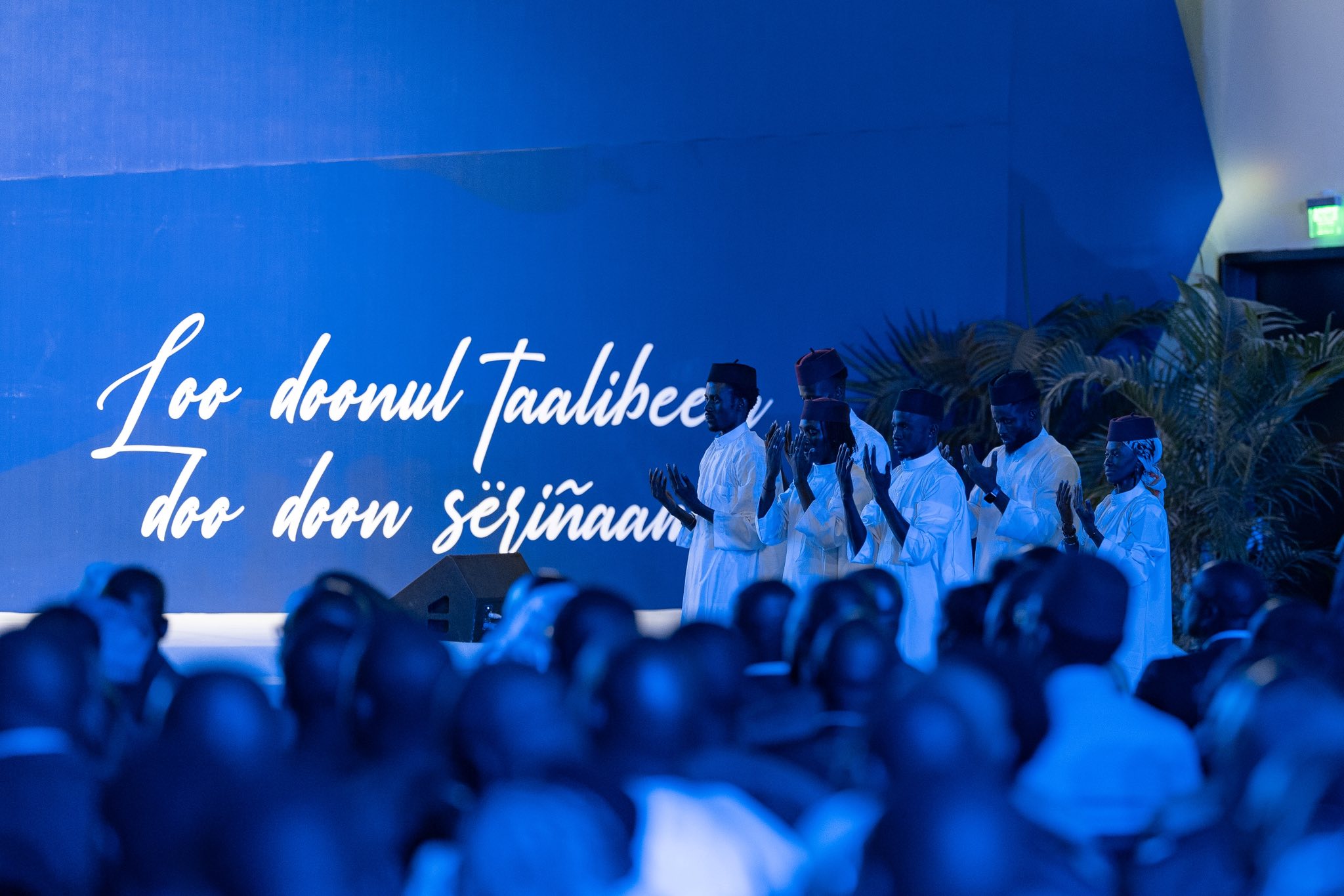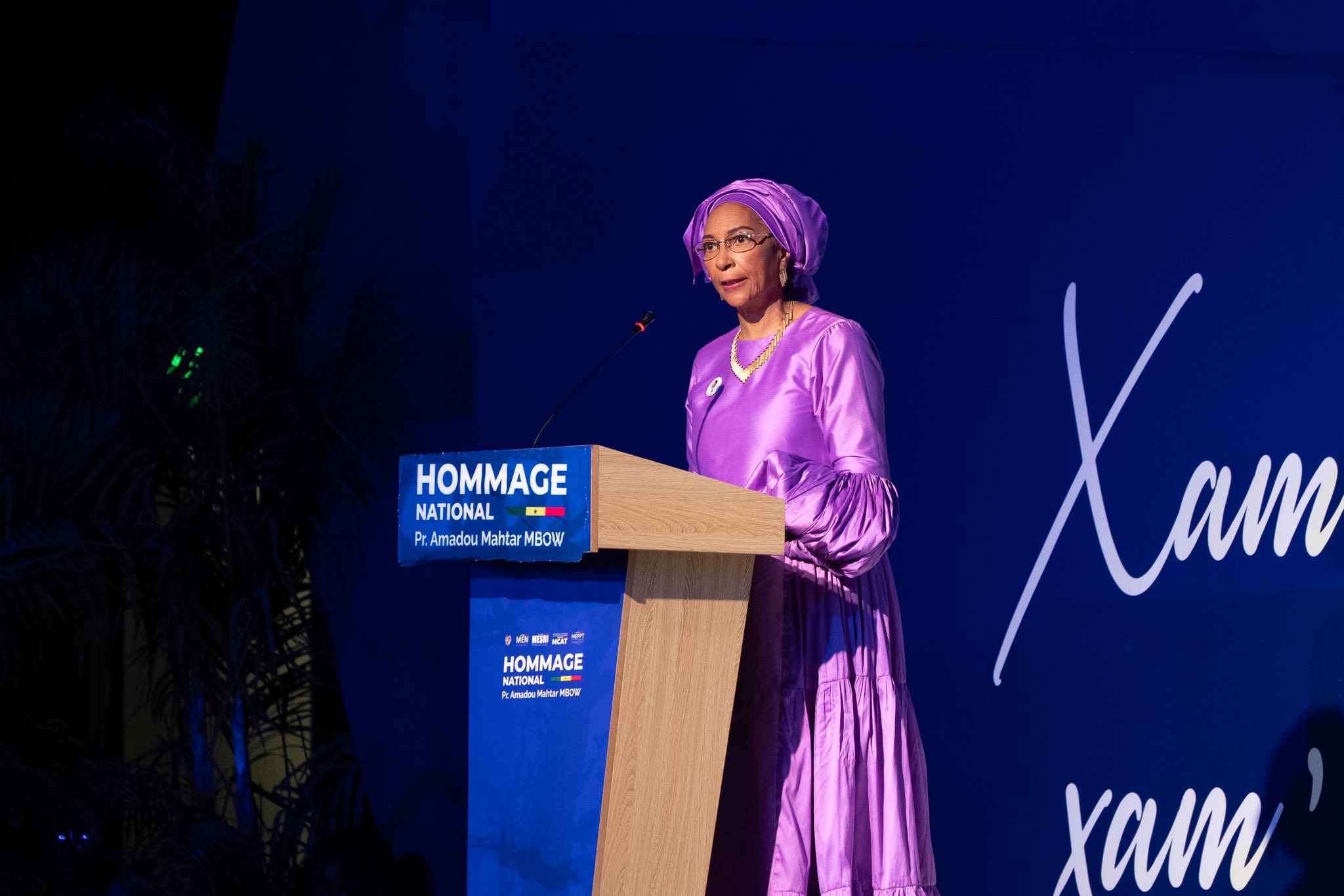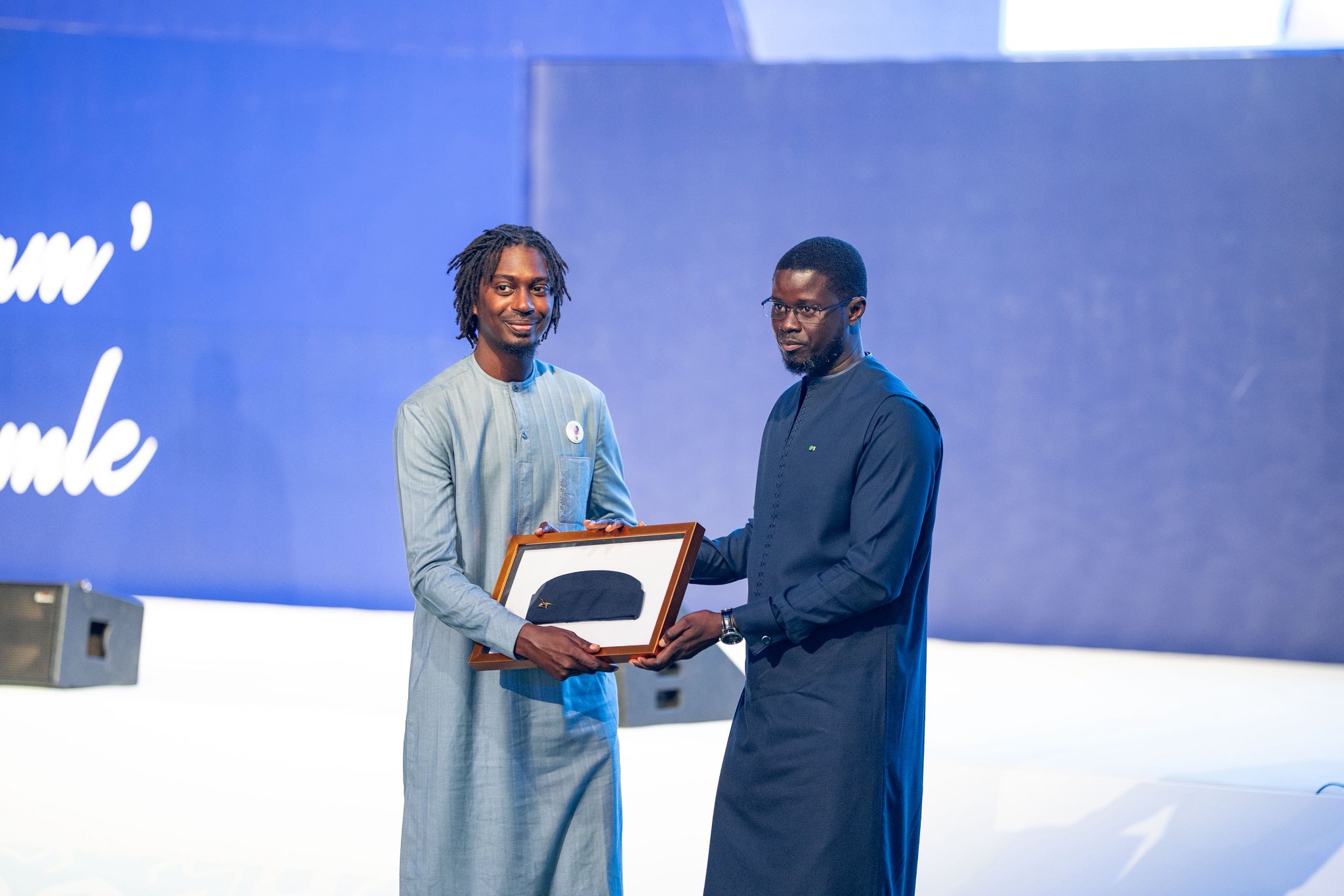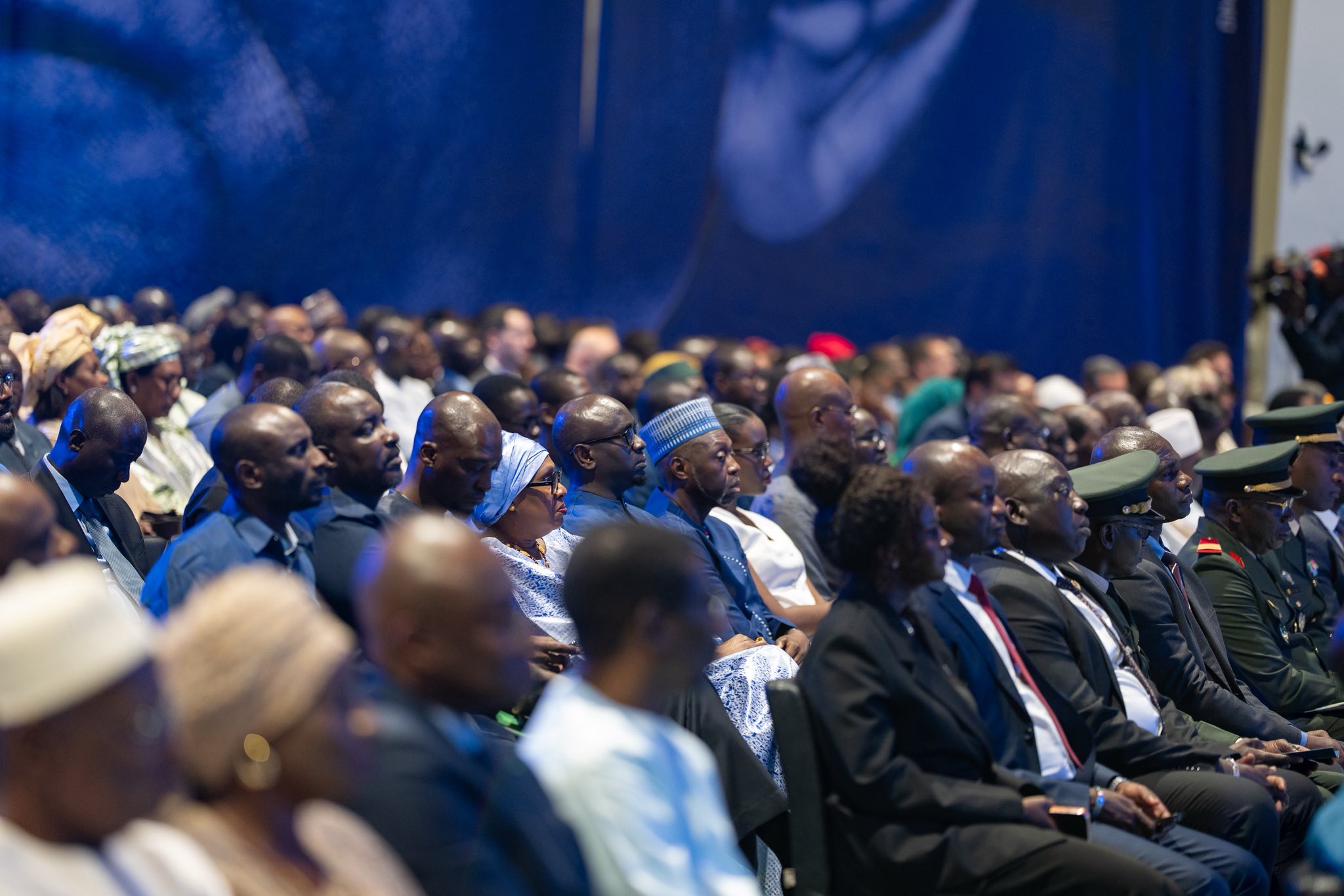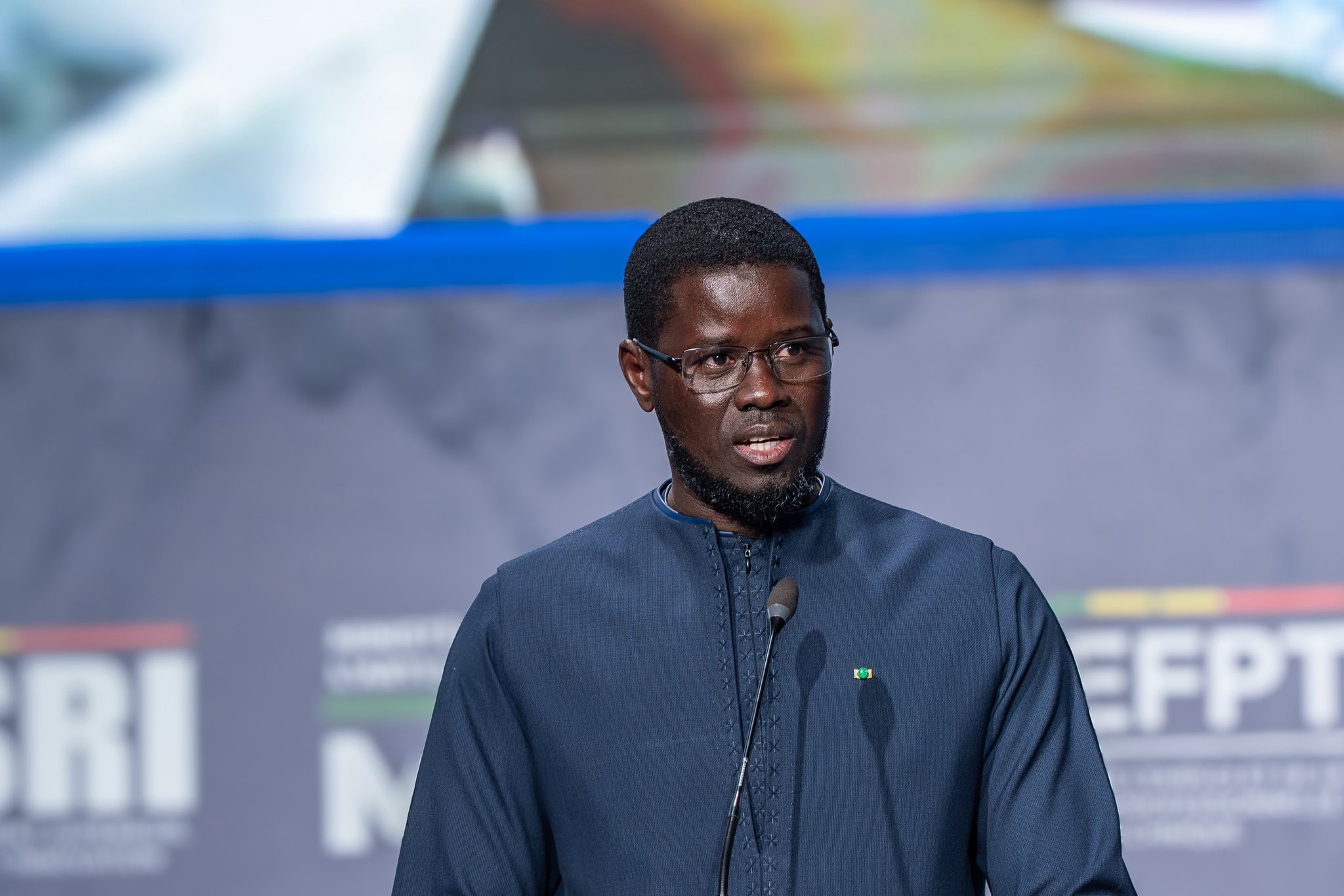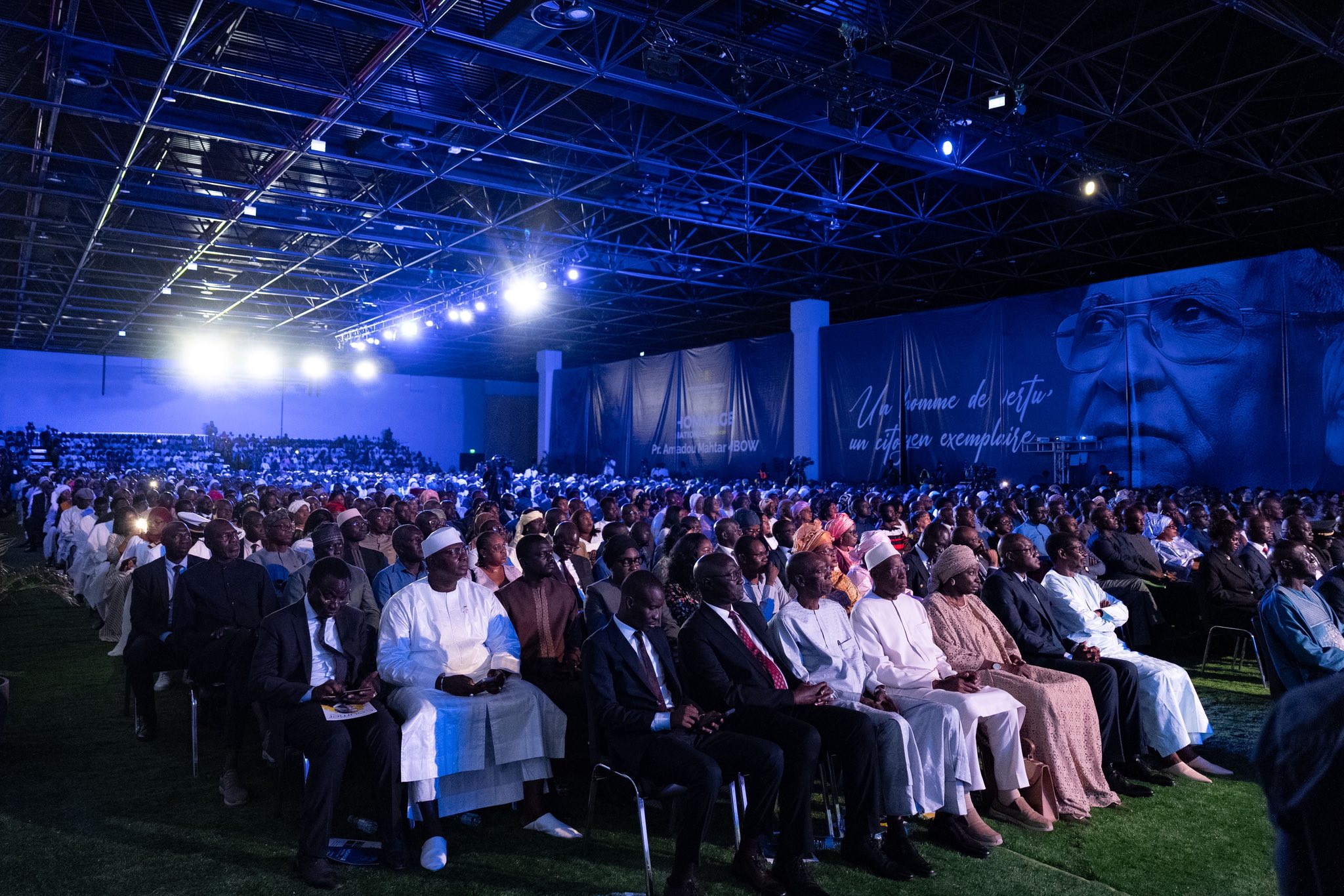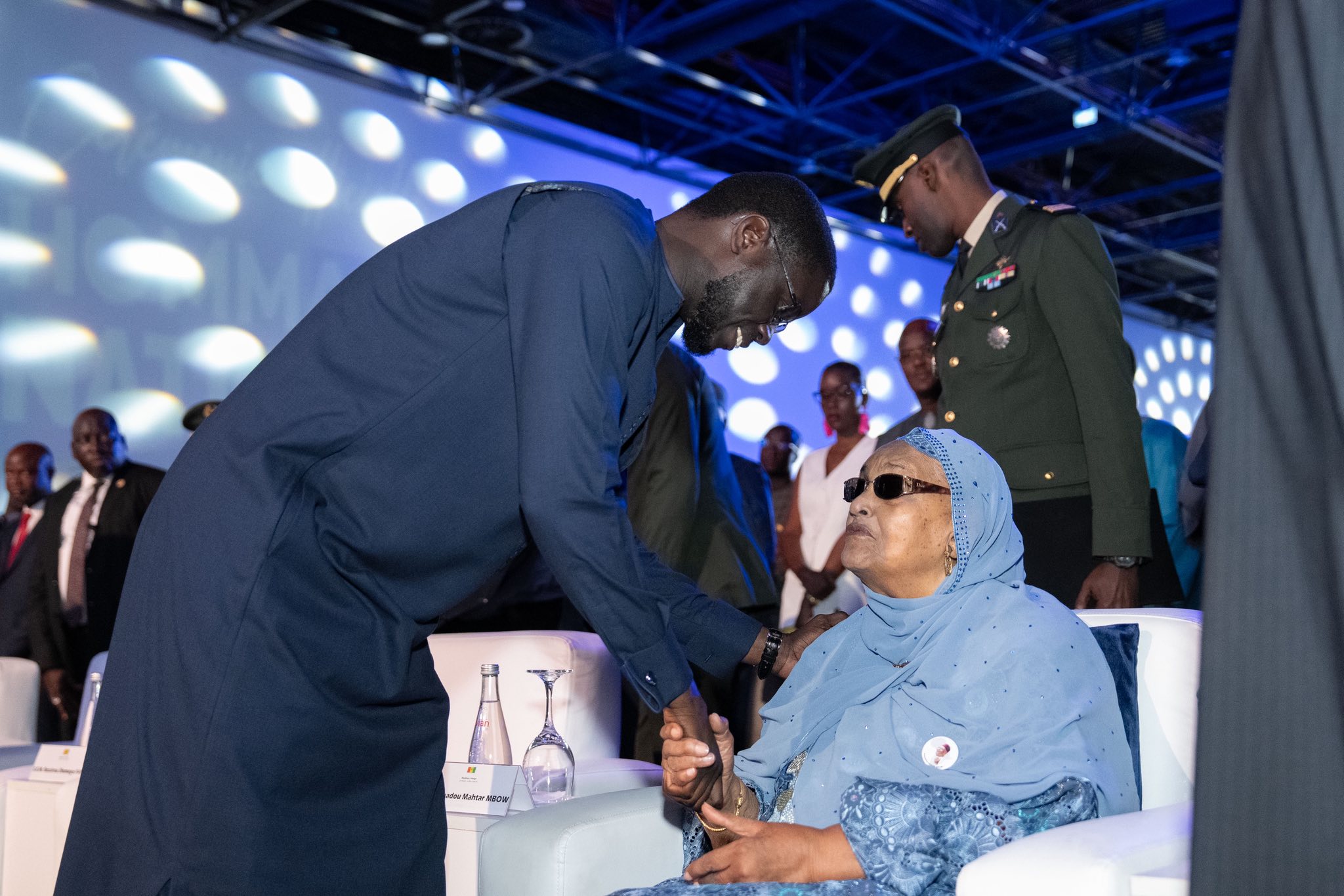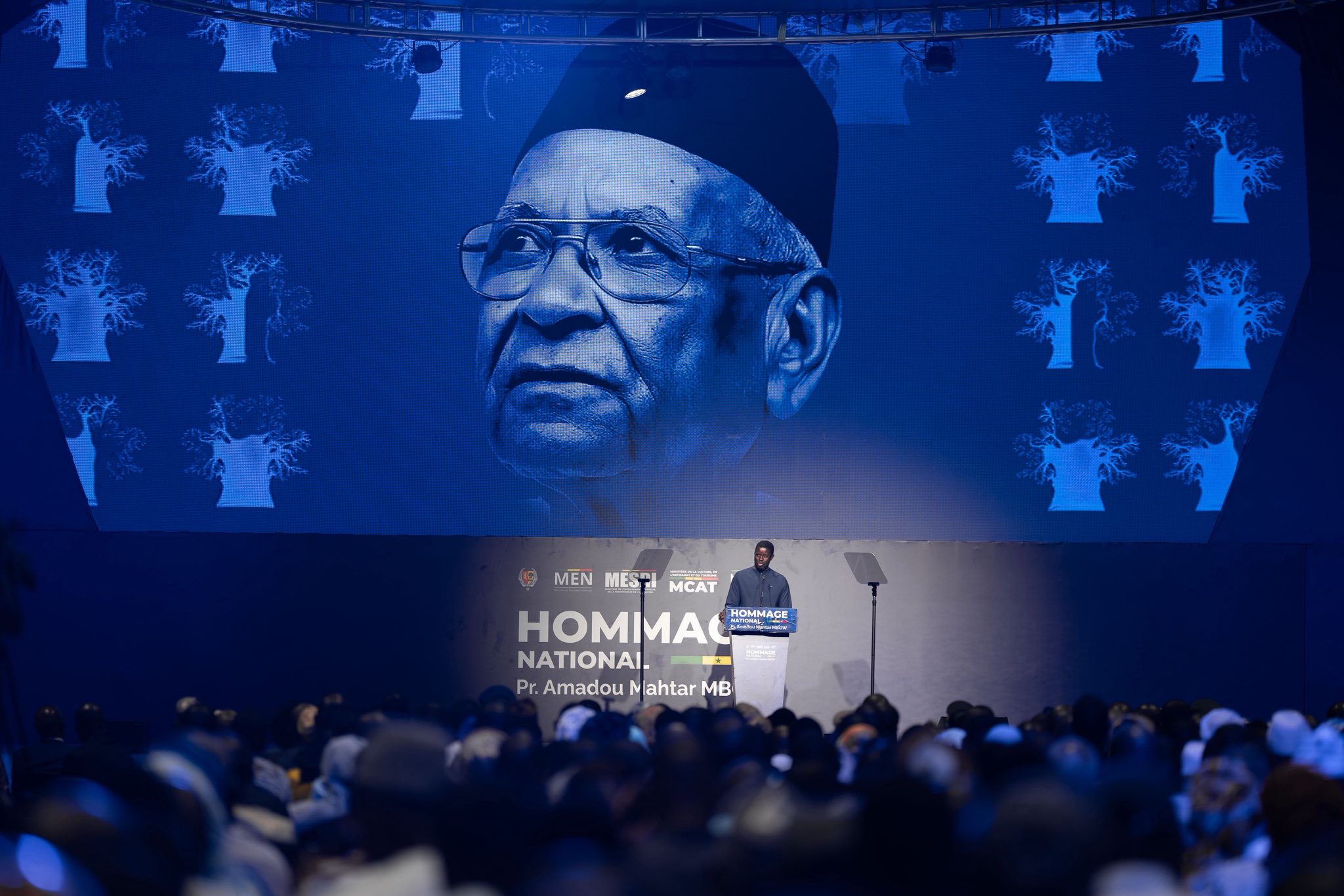
This Tuesday, the Republic of Senegal paid a solemn tribute to Professor Amadou Mahtar Mbow, in the presence of the President of the Republic, Bassirou Diomaye Faye, the family of the deceased, as well as numerous personalities from the educational, diplomatic, and cultural spheres.
A freedom fighter, builder of knowledge, and witness to a century, Amadou Mahtar Mbow embodied the rigor of the mind, the uprightness of public service, and African dignity. From his early lessons in the daaras to the UNESCO rostrum, he made knowledge an instrument of justice and liberation, reminding us that education remains the first act of sovereignty.
His legacy, deeply rooted in the values of knowledge, faith, and humanism, will continue to inspire Senegal's public policies, particularly in building a school of knowledge, responsibility, and human dignity.
By bowing before the memory of Professor Mbow, the Nation pays homage to a man who gave Senegal one of its most beautiful definitions: that of an educated, upright, and united people.
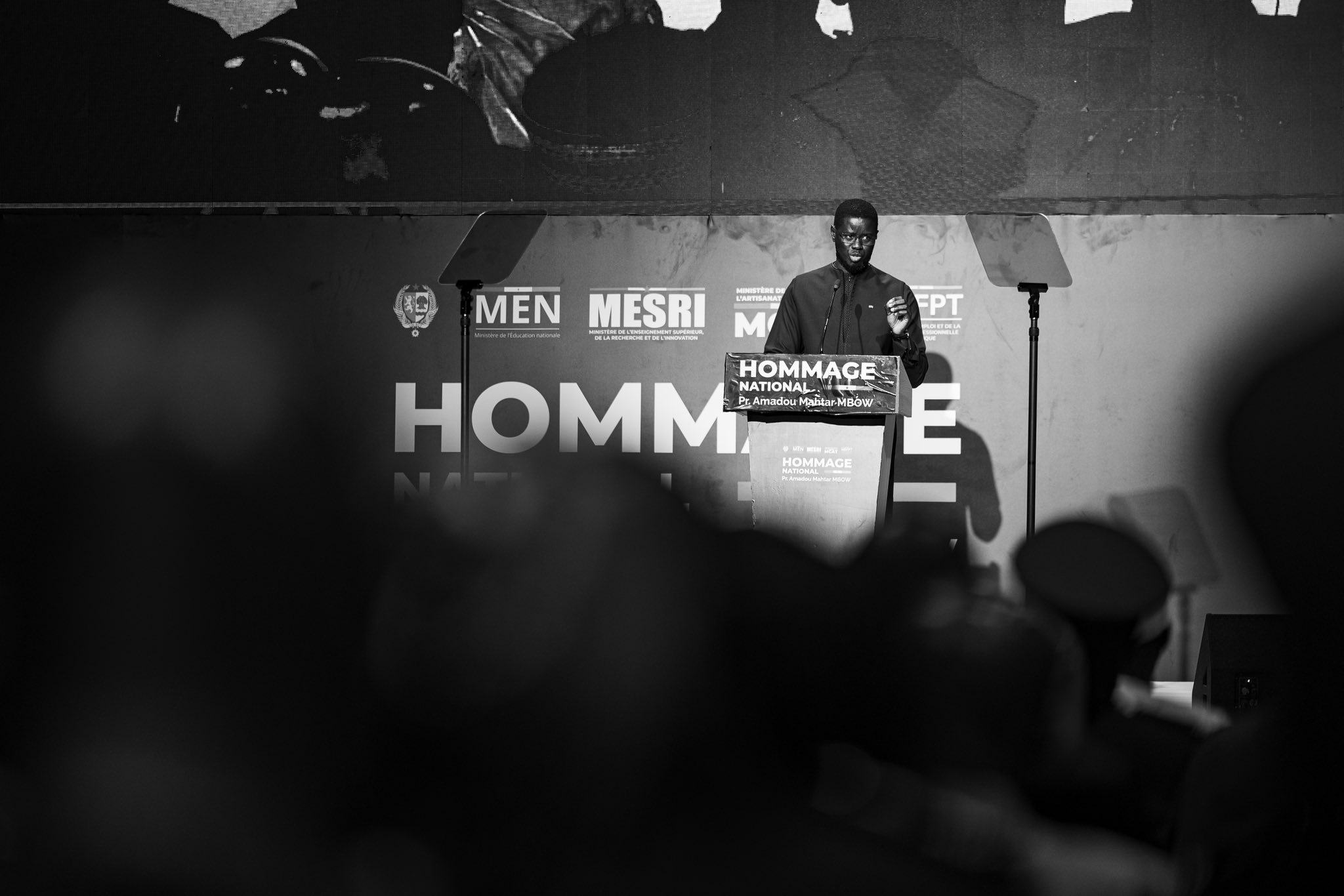
Find the full speech of the President of the Republic of Senegal:
Mr. Prime Minister,
Ladies and Gentlemen, Members of the Government, Mr. Director-General of UNESCO, Ladies and Gentlemen, Representatives of International Institutions, Your Excellencies, Ladies and Gentlemen, Ambassadors, Mr. Rector of Amadou Mahtar Mbow University, Ladies and Gentlemen, Members of the Family and Friends of the Late Mr. Amadou Mahtar Mbow, Distinguished Guests, in Your Ranks, Titles, and Qualities, Ladies and Gentlemen,
We stand at a moment when the nation pays tribute to one of its most illustrious sons, whose journey and actions illuminate our national consciousness and inspire its narrative.
Through my voice, the entire Nation expresses its profound gratitude and celebrates the memory of Amadou Mahtar Mbow.
Etched on the pediment of a Senegalese university, the name of Amadou Mahtar Mbow is elevated to the ranks of the immortals. There is no tribute more symbolic than achieving eternity in the most prestigious place of Knowledge: the University.
Indeed, what other space for socialization and knowledge than the University to foster constructive dialogue between civilizations? The quest for cultural equality among peoples—a pursuit he led through decades of political struggle—remains as relevant as ever.
Rest assured that, as custodians of political power, we will fully assume our role in consolidating the achievements of our glorious predecessors in the fight for the rehabilitation of African history, memory, and dignity—in short, for Pan-Africanism.
Ladies and Gentlemen,
What unites us transcends a ceremony of homage dedicated to one man. We gather to accomplish, together, an act of collective consciousness, a duty of memory, and to honor a rendezvous of the Nation with itself. We gather for a moment in history where memory becomes the matrix of a shared future that we must continually cultivate.
In this regard, celebrating Amadou Mahtar Mbow allows us to envision our future by drawing from the remnants of history the virtues that remain the challenges of the African continent: education, culture, information and communication, equality, and so forth.
Through this celebration, we magnify the policies of memorial reconquest initiated since the beginning of my mandate—whether it be the pursuit of historical truth following the Thiaroye massacre on December 1, 1944, or the restoration to our streets and living spaces of the names of those whose historical imprint has shaped our identity.
Amadou Mahtar Mbow knew that intelligence has value only when it elevates humanity and serves the community; that culture has meaning only if it preserves human dignity and the sovereignty of peoples.
From the excellence of the daaras of his childhood—true places of discipline—to the Senegalese school, he built the foundations of his faith, the discipline of knowledge, and the wisdom of the elders.
From the theaters of operation in the Second World War, he drew the profound conviction that freedom is less a privilege than a moral imperative. In presiding over the destinies of UNESCO, he elevated his functions to the level of a political commitment, becoming the standard-bearer for peoples deprived of voice and recognition.
More broadly, in a world still marked by the fractures inherited from colonization, it is more important than ever to hear the voices rising to affirm that humanity can progress only by recognizing the dignity of all cultures and the equal value of all forms of knowledge.
More than ever, African intellectuals must make Africa’s voice resonate in the tumult of a fragmented world undergoing profound recompositions and, at times, civilizational mutations. More than ever, our societies must encourage and celebrate the voices of those who, throughout the African continent, champion the cause of oppressed cultures, forgotten languages, and unvalued endogenous knowledge.
In truth, the promotion of a culture steeped in our socio-anthropological realities lies at the heart of our public policies. Indeed, Vision Senegal 2050 promotes a Senegal master of its destiny, educator of its children, creator of its knowledge, and proud of its culture.
We firmly believe, through a constructivist approach, that education—far from being an expense—is the provision for all lasting prosperity. It is the very foundation of the conquest of our sovereignties. As a lever for development, education must contribute to the democratization of knowledge and reduce the vulnerabilities affecting countries of the Global South.
Ladies and Gentlemen,
The day that brings us together today demonstrates that culture is not an ornament but the sap that nourishes the Nation, the memory that guides it, and the light that projects it toward the future.
On this October 28, 2025, we certainly honor a man, but we also celebrate a Senegal that believes in the power of knowledge and culture, in the strength of work, and in the greatness of an entire Nation.
We celebrate a Senegal where every school, every university, and every daara aspires to be the custodian of our cultural identity in order to faithfully transmit it to posterity. We celebrate a Senegal where one takes pride in the title of citizen. A Senegal where digital technology and artificial intelligence do not replace the human but elevate it. A Senegal where the technologies of tomorrow serve the eternal values of our civilization: solidarity, justice, truth, and peace.
It is along this trajectory of hope and continuity that we have inscribed the digital transformation of our education system through the Digital Strategy for Education 2025-2029.
This meaningful strategy translates a deep conviction: Africa, once the cradle of much knowledge, must today once again be a source of knowledge that it disseminates to the world. Africa must be a creator of solutions, resources, and endogenous growth.
This sovereign ambition, far from remaining a mere declaration of principle, structures the systemic orientations of our public policies, particularly in the fields of education, training, higher education, research, and innovation—in short, in the epistemology of knowledge.
Africa, as Amadou Mahtar Mbow always taught, must hold its rank as the cradle of humanity to anchor itself in the scientific, digital, and technological mutations of our societies.
However, no scientific progress can exist without roots. And these roots—products of our cultural and social code—are our daaras, our national languages, our traditions, our spirituality; our living together, in the end. We have the sacred duty to preserve our roots in order to better transmit them and to magnify them in order to better inscribe them in modernity.
That is why, in our national curriculum reform, we have placed the daaras at the heart of major transformations: they embody the living link between ancestral wisdom and digital modernity, between memory and innovation, between faith and knowledge.
Ladies and Gentlemen,
Beyond symbols, this tribute is a republican and moral pact. A collective commitment that we owe to history and to future generations.
The Nation is grateful to the family of Amadou Mahtar Mbow, vigilant guardians of his memory.
I also congratulate the Amadou Mahtar Mbow Foundation, whose constant commitment helps keep alive and radiate his intellectual, moral, and humanist legacy. Furthermore, I seize this occasion of the ceremony to pay tribute to all the founding fathers of our national memory and to all the heirs of our great national history.
As you know, my mandate is also that of memorial reconquest, the duty of memory, and the transmission of our intangible and identity heritage.
Ladies and Gentlemen,
In reality, today’s ceremony fits into a broader, more holistic dynamic of reaffirming our sovereignty through the moral and educational refoundation of our country. I thus place great hope in the ongoing overhaul of the education system to bring forth a school founded on the ecology of bonds and places, a school that promotes mathematics, sciences, and technologies, a school that produces humanities and stands at the vanguard of national sovereignty.
This is the full meaning of the NITHÉ initiative (New Initiative for a Humanist Transformation of Education) that I have instructed the Minister of National Education to implement.
Consequently, I urge the youth of Senegal to make their own this assertion by Amadou Mahtar Mbow: “Our destiny is inscribed in no fatality.”
Long live a sovereign, just, and prosperous Senegal!
Long live a united, solidarity-based, and upright Senegal!
Thank you for your attention.
Images: